

Pop culture has trained us to picture angels as glowing, gentle figures with white feathered wings and soft halos. But open an actual Bible, and the picture changes fast. Biblically accurate angels are described with multiple faces, wheels covered in eyes, wings that number in the double digits, and appearances so overwhelming that the very first words out of their mouths are almost always “fear not.”
Most of what people believe about angels actually comes from centuries of art, film, and folklore rather than the biblical text itself. Renaissance painters had to work from imagination, since Scripture rarely gives a full physical description, and later artists simply copied earlier artists. Over time, the image of a soft-featured, robed figure with two white wings became the default — even though it barely resembles most of what’s written in the Old and New Testaments. This article sticks strictly to what Scripture says, verse by verse, so the picture that emerges is grounded in the text rather than tradition.
Why “Biblical Accurate Angels” Became a Trend
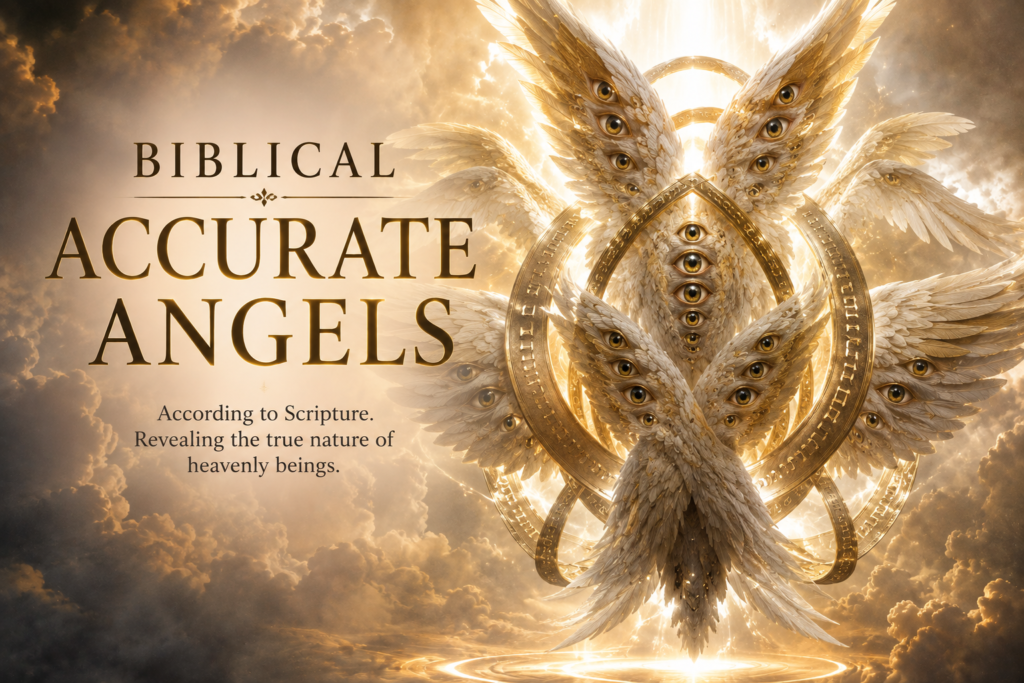
The phrase “biblical accurate angel” started circulating widely online after people began comparing traditional religious art to the actual text of the Bible. The gap was striking. Renaissance paintings gave us soft, human-looking beings with two wings and flowing robes. The Bible, by contrast, describes creatures with burning wheels, six wings covered in eyes, and four faces on a single body.
That contrast is exactly why the topic keeps resurfacing. It isn’t a modern invention or internet joke pulled from nowhere — the strange descriptions are sitting right there in books like Ezekiel, Isaiah, and Revelation. Once people started reading the source material instead of relying on centuries of artistic tradition, the “biblically accurate angel” aesthetic took off.
What the Bible Actually Says Angels Look Like
Not every angel in Scripture looks the same. The Bible describes several distinct categories, and understanding the difference is key to getting an accurate picture.
Angels Who Appear as Ordinary Men
Most angelic encounters in the Bible don’t involve wings, glowing light, or strange creatures at all. Angels frequently appear simply as men — so ordinary that people don’t realize they’re in the presence of a heavenly being.
- Genesis 18 describes three visitors who appear to Abraham as travelers he invites to eat.
- Hebrews 13:2 warns believers to show hospitality to strangers, “for thereby some have entertained angels unawares.”
- Mark 16:5 describes the angel at Jesus’s tomb as “a young man” sitting inside, dressed in a long white garment.
This is one of the most overlooked truths in the “biblically accurate angels” conversation: the majority of angelic appearances in the Bible are visually unremarkable. The drama comes later, with a smaller set of specific angelic beings.
Cherubim: Guardians of God’s Throne
Cherubim are not the chubby infant figures associated with Valentine’s Day art. In Scripture, cherubim are powerful guardian beings tied directly to the presence and holiness of God.
- Genesis 3:24 places cherubim with a flaming sword at the entrance to Eden after Adam and Eve are removed, guarding the way to the tree of life.
- Ezekiel 10:12 describes cherubim as covered “full of eyes round about,” including their bodies, backs, hands, and wings.
- Exodus 25:18-20 instructs that two golden cherubim be placed on the mercy seat of the Ark of the Covenant, wings stretched upward.
Cherubim are consistently linked to guarding sacred space, not delivering gentle messages.
Seraphim: The Six-Winged Burning Ones
Seraphim appear by name only once in Scripture, but the description is unforgettable. The word itself is connected to burning or fire.
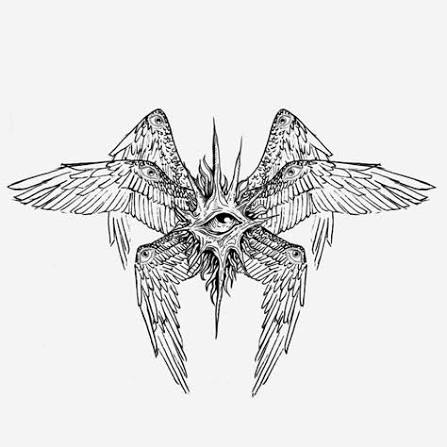
- Isaiah 6:2 says each seraph has six wings: “with twain he covered his face, and with twain he covered his feet, and with twain he did fly.”
- Isaiah 6:3 shows them calling to one another, declaring the holiness of God in a voice powerful enough to shake the temple’s foundations.
Seraphim exist specifically around God’s throne, and their role in Isaiah’s vision is worship, not communication with humans.
Ophanim: The Wheels Within Wheels
Ezekiel’s vision introduces some of the strangest imagery in the entire Bible — living wheels associated with cherubim.
- Ezekiel 1:16 describes their appearance “as it were a wheel in the middle of a wheel.”
- Ezekiel 1:18 adds that “their rings were so high that they were dreadful; and their rings were full of eyes round about them four.”
- Ezekiel 10:9-13 links these wheels directly to the cherubim, moving together as a single unit whenever the cherubim moved.
These beings, often referred to as ophanim, are closely tied to the throne and glory of God rather than functioning as independent messengers.
Types of Angels in the Bible: Quick Comparison
| Angel Type | Key Feature | Main Bible Reference | Primary Role |
| Angels (general) | Often appear as ordinary men | Genesis 18; Hebrews 13:2 | Messengers, protectors |
| Cherubim | Covered in eyes, multiple faces, guard sacred places | Ezekiel 10; Genesis 3:24 | Guardians of God’s presence |
| Seraphim | Six wings, associated with fire and holiness | Isaiah 6:2-3 | Worship, proclaiming God’s holiness |
| Ophanim | Wheels within wheels, rims full of eyes | Ezekiel 1:15-21 | Move with the cherubim and God’s throne |
| Archangels | Named leaders among angels | Jude 1:9; Daniel 10:13 | Spiritual warfare, delivering major messages |
Common Myths the Bible Corrects
Several widely held beliefs about angels don’t actually appear in Scripture. Here are the most common ones worth clearing up.
- Myth: People become angels after death. Nowhere in the Bible do humans transform into angels. Angels are a distinct order of created beings (Colossians 1:16).
- Myth: All angels have wings. Many angelic appearances, especially to Abraham, Lot, and the disciples, describe beings that look like ordinary men with no mention of wings at all.
- Myth: Angels are female or genderless in appearance. Every angel described visually in Scripture that takes human form is referred to using masculine language.
- Myth: Angels are small, cherub-like babies. The cupid-style infant image comes from later European art traditions, not from the biblical text.
- Myth: Guardian angels are guaranteed to everyone individually. While Psalm 91:11 and Matthew 18:10 support angelic protection, the Bible doesn’t describe a fixed, personal guardian assigned the way pop culture often frames it.
Named and Ranked Angels in Scripture
The Bible doesn’t give an exhaustive angelic hierarchy, but it does name a small number of specific angels and describes different levels of angelic beings.
- Michael – Called an archangel in Jude 1:9 and described in Daniel 10:13 as fighting on behalf of God’s people.
- Gabriel – Appears in Daniel 8:16, Daniel 9:21, and Luke 1:26-27 as a messenger who delivers major announcements, including the news of Christ’s birth.
- Lucifer/Satan – Referenced in Isaiah 14:12 and Ezekiel 28, often understood as a fallen angel whose pride led to rebellion.
- The four living creatures – Described in Revelation 4:6-8, combining features of a lion, an ox, a man, and an eagle, and covered with eyes.
Beyond these named figures, the Bible also refers to broader categories of spiritual beings without giving every rank a fixed title. Colossians 1:16 mentions “thrones, or dominions, or principalities, or powers,” suggesting a structured spiritual order that Scripture doesn’t fully spell out. Ephesians 6:12 references “principalities” and “powers” as well, this time in the context of spiritual warfare rather than worship. These references have led many Bible scholars to conclude that angelic beings operate within some kind of organized structure, even though the Bible stops short of laying out a complete chain of command the way later theological traditions have attempted to do.
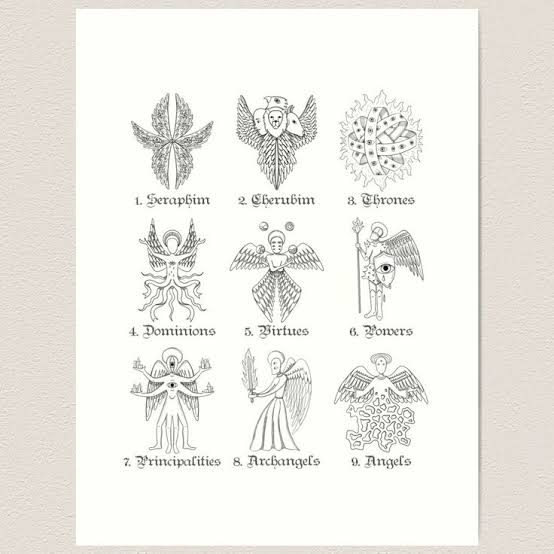
It’s worth noting that much of the detailed angelic hierarchy popularized in art and literature — with nine distinct “choirs” of angels — comes from extra-biblical writings and medieval theology rather than the Bible itself. Scripture gives enough detail to confirm that angels are organized and that some hold greater authority than others, but it doesn’t provide the exhaustive ranking system many assume is biblical.
Key Bible Verses About Angels (KJV)
| Verse | What It Reveals |
| Isaiah 6:2 | Seraphim have six wings and cover their face and feet |
| Ezekiel 1:18 | Wheels (ophanim) are “dreadful” and full of eyes |
| Genesis 3:24 | Cherubim guard Eden with a flaming sword |
| Hebrews 13:2 | Angels can appear as ordinary strangers |
| Psalm 91:11 | Angels are commanded to guard believers |
| Matthew 28:3 | An angel’s appearance is “like lightning” |
| Revelation 4:8 | Four living creatures are “full of eyes within” |
| Daniel 10:6 | An angelic being has a face “like the appearance of lightning” |
Why Angels Look So Overwhelming in Scripture
There’s a theological reason behind the strange, sometimes frightening imagery. Angels in the Bible exist primarily to reflect and serve the holiness of God, not to look comforting or familiar to human eyes. Beings positioned closest to God’s throne — the cherubim, seraphim, and ophanim — are described in the most alien terms, while angels sent as messengers to ordinary people often appear far more human.
This pattern lines up with a consistent theme throughout Scripture: proximity to God’s glory tends to correspond with imagery that emphasizes holiness, power, and otherness rather than approachability. That’s also why so many angelic encounters begin with the phrase “fear not” — the natural human response to these beings is terror, not comfort.
It also explains why the same book of the Bible can describe angels in two very different ways. In Genesis, angels sit down and eat a meal with Abraham like ordinary travelers. In Ezekiel and Revelation, angelic beings are described with multiple wings, faces, and eyes in numbers that are difficult to visualize at all. The difference isn’t a contradiction — it reflects the context of each appearance. A messenger sent to deliver news to a person doesn’t need to reveal the full weight of heavenly glory. A vision of God’s throne room, on the other hand, calls for imagery that communicates just how far beyond ordinary experience that realm truly is.
How This Changes the Way We Picture Angels
Understanding what the Bible actually says doesn’t make angels less meaningful — if anything, it deepens the picture. These aren’t simply gentle guardians handing out blessings. They’re beings created to serve, worship, guard, and deliver the will of God, often in forms that defy easy imagination.
For anyone studying Scripture seriously, it’s worth reading the primary passages directly — Genesis 18, Isaiah 6, Ezekiel 1 and 10, and Revelation 4 — rather than relying only on artistic tradition or internet summaries.
Frequently Asked Questions
Do angels really have six wings?
Only seraphim are described with six wings in Isaiah 6:2. Other angels in Scripture are shown with two wings or no wings at all.
Are cherubim the same as cupids?
No. Cherubim in the Bible are powerful guardian beings covered in eyes, not the infant figures common in later art.
What color are biblically accurate angels?
The Bible rarely assigns specific colors to angels, though Matthew 28:3 compares an angel’s appearance to lightning and Daniel 10:6 describes fiery, bronze-like features.
Do all angels have names in the Bible?
No. Only a few angels, such as Michael and Gabriel, are named. Most angelic appearances describe unnamed messengers.
Can angels be mistaken for humans?
Yes. Hebrews 13:2 and Genesis 18 both describe angels appearing as ordinary men without any visible supernatural features.
Is Satan considered a fallen angel?
Many theologians interpret Isaiah 14:12 and Ezekiel 28 as describing a being who was once a high-ranking angel before rebelling against God.
Why do angels always say “fear not”?
Because their true appearance is described as overwhelming or frightening, angels frequently reassure people before delivering their message, as seen in Luke 1:30 and Matthew 28:5.
Final Thoughts
Biblically accurate angels are far stranger, more varied, and more theologically rich than popular culture suggests. From ordinary-looking messengers to six-winged seraphim and wheel-like ophanim covered in eyes, Scripture paints a picture that prioritizes holiness and purpose over comfort and familiarity. Reading these passages directly — rather than relying solely on centuries of artistic reinterpretation — offers a far more accurate and honestly more fascinating understanding of what the Bible teaches about God’s angelic beings.

I have 7 years of experience with strong knowledge of how to create content that informs and inspires. I am passionate about writing and sharing Bible guidance. To help people grow in faith and understand God’s Word
