

If you’ve come across the word “eunuch” while reading Scripture, you’ve probably paused and wondered what it actually means — and why the Bible mentions it so often. The term shows up more than 40 times across both the Old and New Testaments, tied to kings’ courts, prophecy, and even one of the most powerful conversion stories in the book of Acts.
This guide breaks down the biblical definition of a eunuch, the original Hebrew and Greek words behind the term, the most important eunuchs named in Scripture, and what the Bible ultimately teaches about their place in God’s kingdom.
What Does the Word “Eunuch” Mean in the Bible?
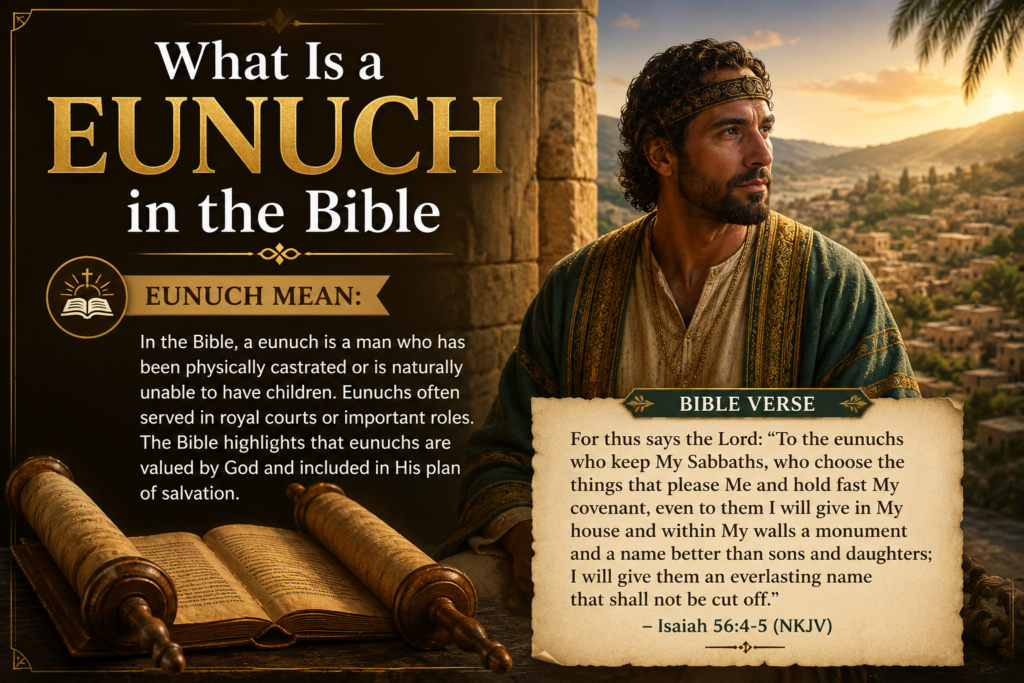
In the simplest terms, a eunuch in the Bible was a male servant or official — often castrated — who worked in close, trusted positions within a royal household. Eunuchs were commonly placed in charge of a king’s harem, treasury, or private chambers because their condition made them “safe” attendants in the eyes of jealous rulers who didn’t want other men near their wives and concubines.
However, the biblical meaning of eunuch is broader than most people assume. Not every person called a eunuch in Scripture was physically castrated. In several cases, the word simply described a high-ranking court official or trusted royal servant, regardless of his physical condition.
The Hebrew Word: Saris
The Old Testament uses the Hebrew word saris (sometimes transliterated cariyc) 45 times. Its meaning developed over time:
- In its earliest use (such as in the story of Joseph in Genesis), saris referred to a royal official or officer — Potiphar, the king’s cupbearer, and the royal baker are all called saris without any implication of castration.
- Later in the Old Testament, saris increasingly described men who had literally been castrated and placed in charge of a royal harem or private chambers.
- Because this practice became so common in the ancient Near East, the word gradually became linked almost exclusively with castration by the time of the exile and post-exilic writings.
The Greek Word: Eunouchos
When Old Testament scribes translated the Hebrew Scriptures into Greek (the Septuagint), they rendered saris as eunouchos in 31 of its 45 occurrences. This same Greek word, eunouchos, appears four times in the New Testament — most notably in Matthew 19 and Acts 8.
Eunouchos carries two related meanings:
- A chamberlain or keeper of a royal bed-chamber — essentially, a high-level palace official.
- A castrated man, or later, someone who voluntarily abstains from marriage and sexual relationships.
Table: Key Biblical Words for Eunuch
| Term | Language | Meaning | Where It’s Found |
| Saris | Hebrew | Royal official; later, a castrated attendant | Old Testament (45 times) |
| Eunouchos | Greek | Chamberlain, castrated man, or celibate person | Septuagint & New Testament (4 times) |
| Cariyc | Hebrew (alt. spelling) | Variant of saris | Old Testament |
Why Were Men Made Eunuchs in Ancient Times?
Castration in the ancient world wasn’t random cruelty — it served a specific political purpose. Rulers across Egypt, Assyria, Babylon, and Persia relied on castrated officials because:
- They could be trusted around the king’s wives and concubines without suspicion of impropriety.
- Without children or a family line of their own to protect, their loyalty was believed to belong entirely to the throne.
- They were seen as less likely to seize power for themselves or start a rival dynasty.
Over time, some eunuchs rose far beyond harem-keeping. Many became powerful court advisers, treasurers, generals, and diplomats — trusted precisely because they had no competing family ambitions.
Famous Eunuchs Mentioned in the Bible
Scripture names or references several eunuchs whose stories carry real theological weight. Here are the most significant.
1. Potiphar (Genesis 37, 39)
Potiphar, the Egyptian official who purchased Joseph as a slave, is called saris in the original Hebrew text — though most English translations simply render this as “officer” or “captain.” Many scholars believe this is an example of the word describing a court title rather than a literal physical condition, since Potiphar is also referred to as having a wife.
2. The Chief Cupbearer and Chief Baker (Genesis 40)
Two of Pharaoh’s officials imprisoned alongside Joseph are also called saris in Hebrew. Their whole story revolves around dream interpretation and Joseph’s rise to power in Egypt.
3. The Eunuchs of Esther’s Court (Book of Esther)
The book of Esther repeatedly mentions eunuchs serving in the Persian royal palace. Hegai, who oversaw the king’s harem, guided Esther through her preparation before King Xerxes (Ahasuerus). Other eunuchs, including Hathach, acted as go-betweens carrying messages between Esther and Mordecai (Esther 4:4-10).
4. Ebed-Melech (Jeremiah 38)
Ebed-Melech was a Cushite (Ethiopian) court official described as a eunuch who rescued the prophet Jeremiah from a muddy cistern where he had been left to die. God later promised to protect Ebed-Melech because of his courageous faith and kindness (Jeremiah 39:15-18).
5. The Ethiopian Eunuch (Acts 8:26-40)
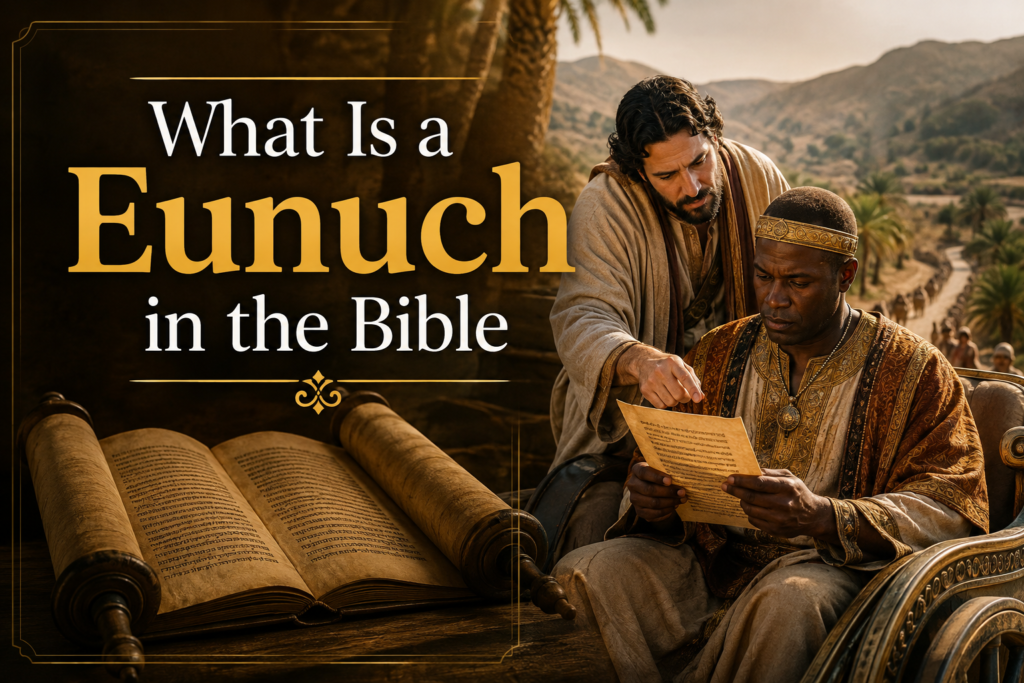
Perhaps the most well-known eunuch in the Bible appears in the New Testament. In Acts 8, Philip the evangelist is led by an angel to meet an Ethiopian court official — described as the treasurer of Candace, Queen of the Ethiopians — who was returning home from worshiping in Jerusalem. He was reading aloud from the prophet Isaiah when Philip approached his chariot.
Philip explained that the passage the eunuch was reading pointed to Jesus Christ. The eunuch believed, requested baptism on the spot, and was baptized in nearby water before continuing his journey rejoicing. This account is widely seen as a landmark moment showing the gospel reaching beyond Israel to the wider Gentile and African world.
What Does Jesus Say About Eunuchs?
The clearest New Testament teaching on eunuchs comes directly from Jesus in Matthew 19:12, during a conversation about marriage and divorce. Jesus identifies three categories of eunuchs:
- Those born eunuchs — men born with a physical condition affecting fertility or sexual desire.
- Those made eunuchs by others — men who were castrated, typically for service in a royal or noble household.
- Those who choose to live as eunuchs — individuals who voluntarily forgo marriage and sexual relationships to devote themselves fully to serving God’s kingdom.
This third category has been especially influential in Christian teaching, often connected to Paul’s later comments on singleness and devotion to ministry in 1 Corinthians 7:7-9. Jesus frames voluntary celibacy not as a curse, but as a calling that “the one who can accept this should accept.”
Table: The Three Types of Eunuchs (Matthew 19:12)
| Type | Description | Cause |
| Born eunuch | Natural physical condition from birth | Congenital |
| Made eunuch | Castrated by human decision | Forced/human action |
| Chosen eunuch | Voluntary celibacy for kingdom service | Personal spiritual choice |
Were Eunuchs Excluded From Worship?
Under Old Testament law, Deuteronomy 23:1 barred men who were castrated from entering “the assembly of the Lord.” This exclusion reflected ancient purity codes tied to physical wholeness and the priesthood, and it left eunuchs in a socially and spiritually painful position — unable to have children to carry on their name, and unable to fully participate in Israel’s worship community.
But the prophet Isaiah delivers a dramatic reversal of that exclusion.
Isaiah 56:3-5 — God’s Promise to Eunuchs
In one of the most tender passages in the Old Testament, God speaks directly to eunuchs through Isaiah:
- He tells eunuchs not to see themselves as “a dry tree” — a phrase reflecting their inability to have descendants.
- He promises that those who keep His Sabbaths and hold to His covenant will receive “a monument and a name” within His house — something described as better than sons and daughters.
- He promises this name will be “everlasting” and “shall not be cut off.”
This prophecy directly foreshadows and is fulfilled in the story of the Ethiopian eunuch’s conversion and baptism in Acts 8. His inclusion into the early church, despite Old Testament restrictions, demonstrates one of the New Testament’s central themes: full acceptance into God’s family through faith in Christ, regardless of physical condition, nationality, or social status.
Quick Reference: Eunuchs in the Bible at a Glance
| Eunuch | Bible Book | Role | Significance |
| Potiphar | Genesis 37, 39 | Egyptian official | Purchased Joseph as a slave |
| Chief cupbearer & baker | Genesis 40 | Pharaoh’s servants | Dreams interpreted by Joseph |
| Hegai & Hathach | Book of Esther | Persian palace officials | Assisted Esther and Mordecai |
| Ebed-Melech | Jeremiah 38-39 | Cushite court official | Rescued Jeremiah, blessed by God |
| Ethiopian eunuch | Acts 8:26-40 | Treasurer to Queen Candace | First recorded African convert, baptized by Philip |
Key Takeaways: What Eunuchs in the Bible Teach Us Today
- The word “eunuch” in Scripture is not always about castration — it often described a trusted royal official or officer.
- Eunuchs held real influence in ancient courts, from Egypt to Persia to Ethiopia.
- Old Testament law excluded castrated men from full worship, but Isaiah 56 promises them honor, belonging, and an everlasting name in God’s house.
- Jesus expanded the conversation in Matthew 19:12, honoring those who remain unmarried for the sake of God’s kingdom.
- The Ethiopian eunuch’s baptism in Acts 8 stands as one of the clearest biblical pictures of God’s grace extending to every nation, background, and physical condition.
Taken together, these passages reveal a consistent thread running through Scripture: no one is too marginalized, too different, or too excluded to be welcomed into God’s family.
How Should Christians Understand Eunuchs Today?
Modern readers sometimes skip past the eunuch passages, assuming they’re irrelevant to contemporary faith. But theologians and pastors continue to point to these texts as some of the clearest biblical examples of God’s heart for people on the margins.
Consider what the eunuch narratives collectively demonstrate:
- Physical condition doesn’t determine spiritual worth. Isaiah 56 makes it explicit — a “dry tree” can still bear an everlasting name in God’s house.
- Social exclusion is not the final word. Old Testament law barred eunuchs from full worship, yet the gospel in Acts 8 reverses that barrier entirely.
- Faithfulness matters more than status. Ebed-Melech wasn’t a priest or a prophet, but his obedience earned him a direct promise of protection from God.
- Singleness can be a calling, not a deficiency. Jesus’ words in Matthew 19:12 gave dignity to those who remain unmarried for kingdom purposes, a teaching Paul later builds on in his letters to the Corinthian church.
For Bible students, the eunuch passages also offer a helpful case study in how a single word can carry layered meaning depending on context — a reminder to always check surrounding verses, historical background, and cross-references before drawing conclusions from a single term.
Where to Read More in Scripture
If you want to study eunuchs in the Bible further, these passages are the best starting points:
- Genesis 37:36; 39:1 — Potiphar described as saris
- Genesis 40:2, 7 — the cupbearer and baker
- Esther 4:4-10 — Hegai and Hathach
- Jeremiah 38:7-13; 39:15-18 — Ebed-Melech’s rescue of Jeremiah
- Isaiah 56:3-5 — God’s promise to eunuchs
- Matthew 19:11-12 — Jesus’ teaching on the three types of eunuchs
- Acts 8:26-40 — the Ethiopian eunuch’s conversion and baptism
Reading these passages together, rather than in isolation, gives the fullest picture of how the biblical understanding of eunuchs shifted from a purely political or social title into a powerful symbol of God’s inclusive grace.
Frequently Asked Questions
What is the biblical definition of a eunuch?
A eunuch in the Bible is typically a castrated male servant of a royal court, though the Hebrew word saris was also used more broadly for trusted government officials.
How many times is “eunuch” mentioned in the Bible?
The Hebrew word saris appears 45 times in the Old Testament, and the Greek word eunouchos appears four times in the New Testament.
Who was the most famous eunuch in the Bible?
The Ethiopian eunuch in Acts 8, treasurer to Queen Candace, is the most well-known, celebrated for his conversion and baptism under Philip’s teaching.
Does the Bible allow eunuchs to worship God?
Deuteronomy 23:1 originally excluded eunuchs from the assembly, but Isaiah 56:3-5 promises them an everlasting place and name within God’s house.
What did Jesus say about eunuchs?
In Matthew 19:12, Jesus describes three types of eunuchs — born, made, and those who choose celibacy for the sake of God’s kingdom.
Was Potiphar a literal eunuch?
Potiphar is called saris in Hebrew, a title also used for court officials generally, and Scripture describes him as having a wife, so many scholars view the term here as an official title rather than a physical description.
Why is Isaiah 56 important for understanding eunuchs?
Isaiah 56 reverses the Old Testament exclusion of eunuchs, promising them honor and an everlasting name in God’s house if they remain faithful to His covenant.

I have 7 years of experience with strong knowledge of how to create content that informs and inspires. I am passionate about writing and sharing Bible guidance. To help people grow in faith and understand God’s Word
