

Millions of people say the words “God grant me the serenity to accept the things I cannot change” without knowing where the prayer came from or why it still resonates almost a century later. Whether you found it stitched onto a pillow, heard it at a 12-step meeting, or came across it during a hard season of life, the Serenity Prayer has a way of landing exactly when you need it.
This guide walks through the complete prayer, its history, the meaning behind each line, and practical ways to use it as a daily tool for calm and clarity.
What Is the Serenity Prayer?
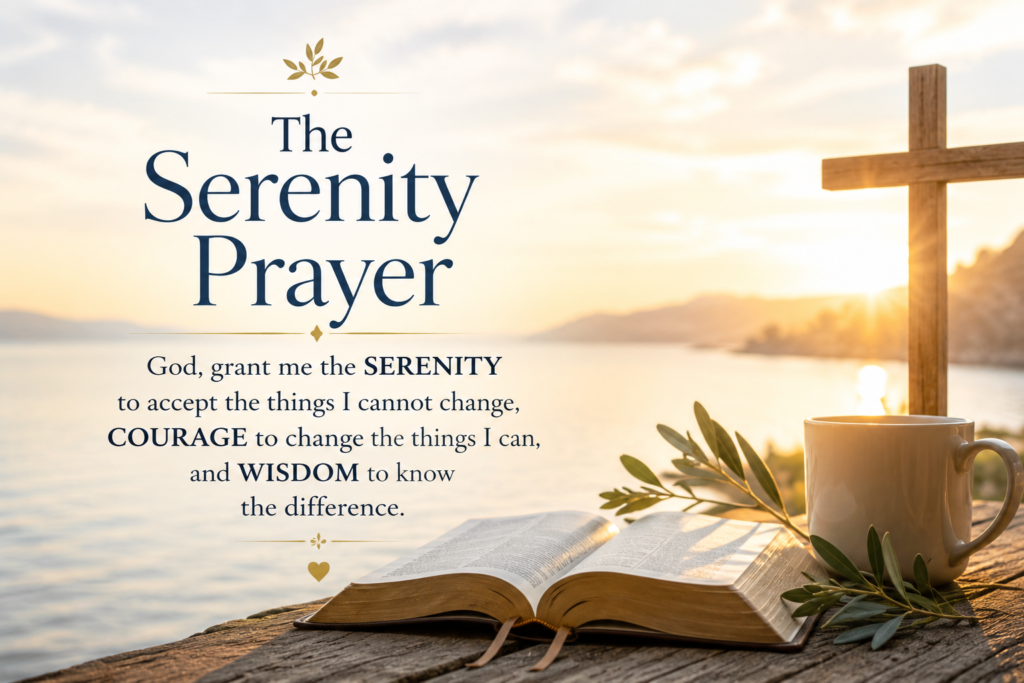
The Serenity Prayer is a short spiritual petition asking for three things: peace to accept what cannot be changed, courage to change what can be changed, and the wisdom to tell the two apart. It’s one of the most quoted prayers in the English language, recited in churches, therapy rooms, and recovery meetings around the world.
Its popularity comes from its simplicity. In just a few lines, it addresses one of the hardest struggles in life — knowing when to let go and when to act.
Full Text of the Serenity Prayer
There are two commonly used versions: the short version most people know by heart, and the longer, original version that includes several additional lines.
Short Version (Most Widely Known)
God, grant me the serenity to accept the things I cannot change, courage to change the things I can, and wisdom to know the difference.
This is the version printed on jewelry, tattoos, and recovery chips. It’s the one people memorize first.
Full (Long) Version
God, grant me the serenity to accept the things I cannot change, courage to change the things I can, and wisdom to know the difference.
Living one day at a time, enjoying one moment at a time, accepting hardship as the pathway to peace.
Taking, as Jesus did, this sinful world as it is, not as I would have it.
Trusting that He will make all things right if I surrender to His will, so that I may be reasonably happy in this life, and supremely happy with Him forever in the next.
Amen.
The longer version is less commonly quoted but adds meaningful depth. It shifts the focus from a single request into a broader outlook on patience, humility, and trust.
Who Wrote the Serenity Prayer?
The prayer is generally credited to American theologian Reinhold Niebuhr, who is believed to have composed it sometime in the 1930s or early 1940s. Niebuhr reportedly used a version of the prayer in a sermon, and it later spread through church bulletins, wartime chaplain materials, and eventually recovery communities.
There’s some historical debate about the exact date and originality of the prayer, since similar sentiments appear in earlier writings and other faith traditions. Regardless of its precise origin, Niebuhr’s version is the one that became famous worldwide.
| Detail | Information |
| Attributed author | Reinhold Niebuhr |
| Estimated origin | 1930s–1940s |
| First popular use | Church sermons and wartime materials |
| Later adoption | Alcoholics Anonymous (1940s onward) |
| Common nickname | “The AA Prayer” |
Why Is It Called “The AA Prayer”?

Alcoholics Anonymous adopted the Serenity Prayer in the 1940s after a member came across it and suggested it for meetings. It fit perfectly with the program’s core philosophy: accept what you can’t control, take responsibility for what you can, and use sound judgment to know which is which.
Today, it’s recited at the start or close of countless AA, NA, and other 12-step meetings. Many members carry a version of it on a recovery token or chip as a daily reminder of the program’s core principles.
Line-by-Line Meaning of the Serenity Prayer
Breaking the prayer down phrase by phrase makes its purpose much clearer.
“Grant me the serenity to accept the things I cannot change”
This line is a request for inner peace, not passivity. It’s about releasing the need to control outcomes that are genuinely outside your influence — other people’s choices, the past, or circumstances beyond your reach.
“Courage to change the things I can”
This is the action half of the prayer. It acknowledges that some things do fall within your control, and it takes bravery to actually do something about them instead of avoiding responsibility.
“And wisdom to know the difference”
Arguably the hardest part. Telling the difference between what you can and cannot change requires honest self-reflection, and this line asks for the clarity to make that call correctly.
“Living one day at a time”
A reminder not to get overwhelmed by the future. Recovery programs use this phrase constantly because long-term goals can feel impossible, but a single day usually feels manageable.
“Accepting hardship as the pathway to peace”
This reframes struggle. Instead of viewing difficulty as something to resent, it treats hardship as part of the process that leads to a calmer, more grounded life.
“Trusting that He will make all things right if I surrender to His will”
For those who pray it in a religious context, this line is about letting go of the need to micromanage every outcome and trusting a higher power with the results.
Is the Serenity Prayer in the Bible?
No, the exact wording of the Serenity Prayer does not appear anywhere in Scripture. However, its message closely mirrors several biblical themes, including:
- Philippians 4:6-7 — on releasing anxiety through prayer and finding peace beyond understanding.
- Philippians 4:11 — on learning contentment in any circumstance.
- James 1:5 — on asking God for wisdom.
- Proverbs 3:5-6 — on trusting rather than relying solely on personal understanding.
Because the themes align so closely with Christian teaching, many mistake it for a direct Bible verse, even though it’s a modern composition.
Different Versions Across Faiths and Cultures
While the prayer began in a Christian context, it has been adapted by other traditions over the decades.
| Tradition | Common Adaptation |
| Protestant Christian | Classic short version, largely unchanged |
| Catholic | Often includes an additional line about salvation |
| Jewish communities | Sometimes reworded to remove specifically Christian references |
| Secular / recovery groups | “God” replaced with “a higher power” or omitted entirely |
| Buddhist-influenced adaptations | Focused on acceptance and mindfulness without a deity reference |
This flexibility is part of why the prayer has traveled so far beyond its original religious setting — its core message of acceptance, courage, and wisdom applies to almost anyone, regardless of belief system.
How to Use the Serenity Prayer in Daily Life
You don’t need to be in recovery or religious to benefit from this prayer. Here are practical ways people use it:
- Morning grounding. Say it first thing in the morning to set a calm, intentional tone for the day.
- In moments of frustration. Repeat it silently when you feel anger or anxiety building over something outside your control.
- Journaling prompt. Write down one thing you cannot change, one thing you can, and one action step — then reflect on what wisdom is telling you.
- Before difficult conversations. Use it to separate what you can control (your words, your tone) from what you can’t (the other person’s reaction).
- As a bedtime reflection. Review the day and mentally sort what actually needed your energy versus what didn’t.
Common Situations Where the Prayer Helps
| Situation | How the Prayer Applies |
| Recovery from addiction | Accepting powerlessness over substances while taking responsible daily action |
| Grief and loss | Accepting what has happened while finding the courage to move forward |
| Workplace stress | Letting go of things outside your job description while acting on what you control |
| Parenting challenges | Accepting a child’s choices as they grow while guiding what’s within your influence |
| Chronic illness | Accepting physical limits while pursuing treatment and lifestyle changes that help |
Tips for Memorizing the Prayer
- Write it on a card and read it once each morning and evening.
- Break it into three parts (serenity, courage, wisdom) and learn one phrase at a time.
- Say it out loud rather than only reading it silently — verbal repetition builds memory faster.
- Pair it with a specific daily action, like reciting it while making coffee, so it becomes a habit trigger.
Why the Serenity Prayer Still Resonates Today
Life constantly hands people situations that feel unfair or unchangeable, alongside situations that genuinely require action. The Serenity Prayer works because it doesn’t promise that life will get easier. Instead, it offers a mental framework for facing whatever comes — accept what you must, act on what you can, and trust yourself enough to know the difference.
That’s likely why, nearly a century after it was first written, the prayer still shows up on coffee mugs, recovery chips, hospital room walls, and quiet morning routines everywhere.
Mistakes People Make When Applying the Prayer
Even though the words are simple, putting the prayer into practice trips people up in a few common ways.
- Treating acceptance as giving up. Accepting something you can’t change doesn’t mean you stop caring or stop hoping. It means you stop wasting energy fighting a reality that won’t budge.
- Skipping the wisdom step. Many people jump straight to “accept it” or “fix it” without pausing to honestly figure out which category a situation belongs in. That pause is the whole point of the prayer.
- Using it to avoid responsibility. Some people quote the prayer to excuse inaction on things they actually could change, like an unhealthy habit or a conversation they’re avoiding.
- Reciting it without reflection. Saying the words on autopilot loses most of the benefit. The prayer works best when paired with a real, specific situation you’re facing.
Recognizing these patterns helps the prayer function the way it was intended — as a daily filter for decision-making, not just a comforting phrase.
Frequently Asked Questions
Who originally wrote the Serenity Prayer?
It’s widely attributed to theologian Reinhold Niebuhr, who is believed to have written it sometime in the 1930s or 1940s.
Is the Serenity Prayer a Bible verse?
No, it isn’t found word-for-word in Scripture, though its message reflects several biblical themes about peace, trust, and wisdom.
Why is it called the AA Prayer?
Alcoholics Anonymous adopted it in the 1940s, and it became a core part of 12-step meetings, leading to this nickname.
What’s the difference between the short and long versions?
The short version is the well-known three-line request for serenity, courage, and wisdom. The long version adds several more lines about daily living, acceptance of hardship, and trust in God’s will.
Can non-religious people use the Serenity Prayer?
Yes. Many secular and recovery groups replace “God” with “a higher power” or simply use the prayer as a personal mantra without any religious framing.
How is the Serenity Prayer used in recovery programs?
It’s recited at meetings and used as a daily reminder to accept what can’t be controlled, take action on what can, and grow the wisdom to distinguish the two.
Is there a specific time of day to say the prayer?
There’s no required time. Many people say it in the morning to set intentions or at night to reflect on the day.
Final Thoughts
The Serenity Prayer isn’t just a set of comforting words — it’s a practical way of thinking that applies to nearly every hard situation life throws at you. Whether you’re navigating recovery, grief, stress, or simply a rough week, its three requests — serenity, courage, and wisdom — offer a simple but powerful place to start.
You don’t have to belong to any particular faith or program to find value in it. Say it when you need grounding, return to it when life feels chaotic, and let its structure guide you toward calmer, more intentional decisions.

I have 7 years of experience with strong knowledge of how to create content that informs and inspires. I am passionate about writing and sharing Bible guidance. To help people grow in faith and understand God’s Word
